

Last week I reviewed Stephen King’s On Writing for two reasons. I was preparing for a Community Center class I hope to teach this fall that will help wanna-be writers to get in the daily writing habit. I now believe such a habit is the foundation for creating and finishing works of prose. But I also wanted to review his ideas while I rework my Unstoppable novel.
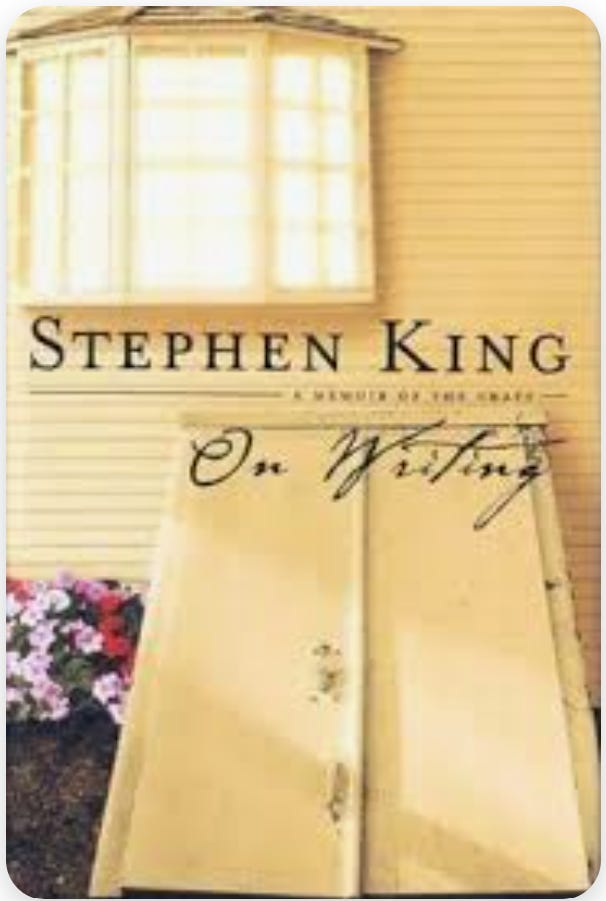
Less than half of On Writing is about the writing process, but there’s good stuff between pages 150 and 250. Including his statement about plotting: he doesn’t. Plotting and the spontaneity of real creation aren’t compatible, he says. This statement puts plotters in a tizzy. Some writing theorists go as far as to say that King and his ilk are lying. They’re plotting in secret, or just doing the work in their head. No stickies on the wall, no Save the Cat! 15-point structure in tables on the computer, no messy spiral notebooks. But they’re doing it nonetheless.
The plotter/pantser argument (they’re called “pantsers” because they write from the seat of their pants) became scarily tangible to me as reworking the middle of Unstoppable while rereading King. I was merrily reshaping my chapters, following my repeating “action scene/response scene” structure (see my prior posts for more information). I came upon two action scenes in a row. A “Sequel” scene needed to go between them. This wasn’t the first time I’d come upon such a situation. Usually I pull from material around the action scenes, reaching forward or backward in the story. Sometimes I’ve taken an action scene and switched it to a conversation the characters are having, or I had one of the characters mention the event in passing.
But for these two particular action scenes? I had nothing. Zip. Nada.
At this point in the novel, the protagonist, Kelsey, is afraid to talk with her new boyfriend. She’s mad at her best friend. She suspects that her school newspaper mentee is being friendly only to pump her for information. She can’t talk to her parents about what is happening. In short, she has no one to react to. How can this work?
I will make it work, I told myself. Dumb luck got me to draft 13. Let’s go!
So I sat down at the computer with one word: “Hello.” That was all I had.
I can’t say that I hadn’t been thinking about what to write. I also am a great believer in the subconscious writing along with the conscious part of your brain. It feeds you ideas and smooths out problems before you ever get to them. It works 24/7, so sometimes when I’m stuck on a scene I will sleep on it, and, voila, I wake up and the problem is solved. King refers to this process as “the boys in the basement,” but doesn’t elaborate.
After typing “hello,” it hit me. The only person Kelsey is still talking to is her great tormentor, the antagonist of the novel, Superintendent Rivers of Kelsey’s school district. So far Dr. Rivers has been texting Kelsey, never her initiating. Each time he texts, he assigns Kelsey more work. His secret hope is to get her to resign the editorship of the newspaper so he may put in someone more sympathetic to his wishes. But now, Kelsey is texting him? Why?
I was shocked at what rolled out of my brain onto the computer screen. Instead of Kelsey being her deferential self, she confronted Rivers about everything. Why is he overworking her? Why is he trying to push her out? What about the missing newspaper account money (the inciting incident for the novel)?
I don’t think I could have created this scene were I logically plotting out the story as I usually do. When I finished their text exchange, it not only suited the response/dilemma/decision structure of the “Sequel” scene. It felt essential. The exact thing Kelsey needed to do at the moment. The scene deepened character while upping the tension.
In my creative writing classes I have harped on the importance of plotting. But my student Tonja called me on it more than once, and now, looking back, I see that a lot of my writing is done by the seat of my pants. Little phrases that come to me. Parts of scenes I didn’t know I needed until I was writing the scene. Twists have come out of the blue. Suddenly deleting paragraphs on a whim.
How should I adjust my writing process to allow for what I really do? I don’t know. The process as it stands today is to plot the hell out of a story, and then, as I write it, change everything around moment by moment to make the story as enjoyable as I can make it. This creates a lot of work. A lot of going-back-over work.
I think of Chaucer writing evenings in London seven hundred years ago. The Brit Lit text I used to teach described how his ink would freeze as he put his ideas to paper. Shakespeare sharpening his quills as he wrote his ideas down. How did they revise? How did they rework their scenes, not only getting ideas down but making sure the verse sung?
Or, echoing King, maybe it just came out that way.
It boggles the mind.